Corporate Training • Always On Learning • HRDC Claimable
Always On Learning Model: Why One Off Corporate Training No Longer Works
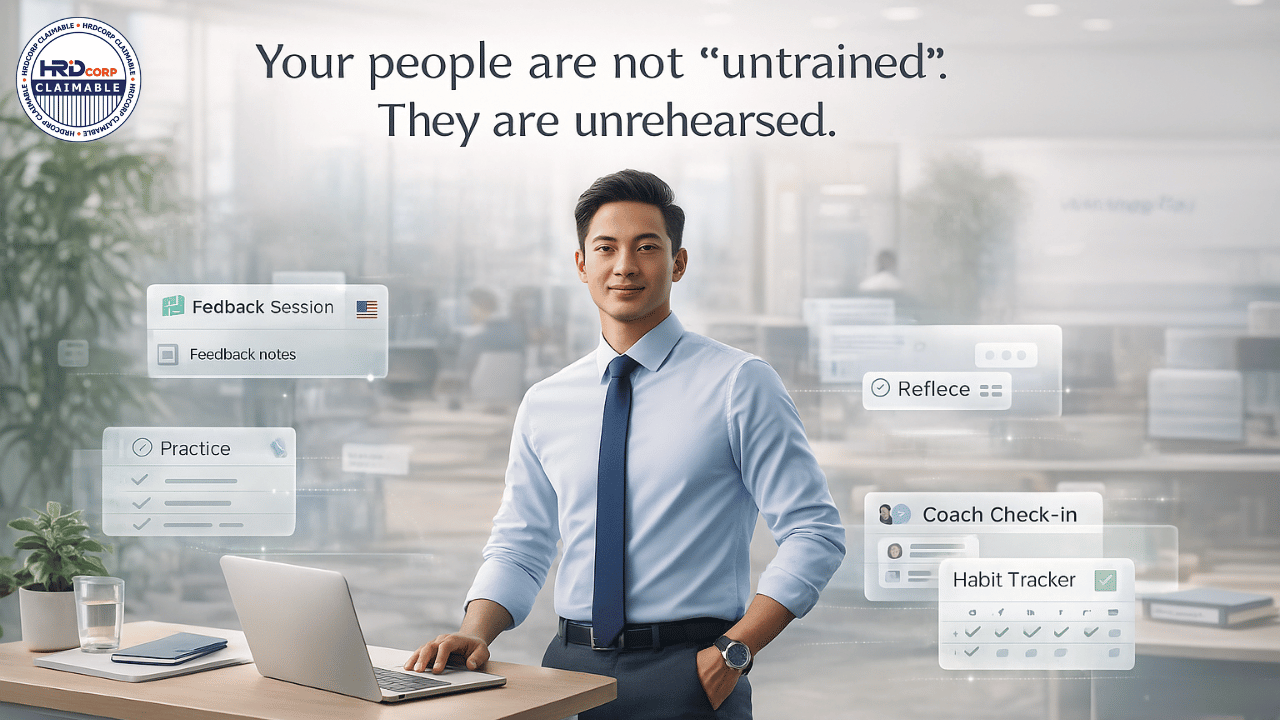
Most training feels productive in the room — then Monday happens. This article breaks down why one off workshops fail and how Always On learning turns training into behaviour change that survives real work.
Introduction
Most corporate training feels productive in the moment. You book a corporate trainer, the room is full, the slides look sharp, people nod, everyone leaves with a workbook and a little hope.
Then Monday happens.
Deadlines return, WhatsApp pings start again, managers go back to firefighting, and the new skill disappears quietly. Not because the session was “bad”, but because learning was treated like an event instead of a system.
That is the core reason one off workshops do not cut it anymore. Today’s workplace is too fast, too distracted, and too complex. What employees need is not just employee training. They need an employee training program designed to survive real work, real stress, real people, and real habits.
This is where the Always On Learning Model becomes a game changer. It is a corporate training approach that builds behaviour through repetition, reinforcement, coaching, and practical application, supported by strong human resources training and development practices.
Why one off corporate training fails, even when the trainer is great
One off workshops often fail for reasons that have nothing to do with the corporate instructor or the content.
Learning needs repetition, not inspiration
Skills do not become habits in a single session. A staff training program works when learners practice, reflect, and apply multiple times, across real situations.
Work pressure erases memory fast
Even the best management training for managers gets overridden by urgent operational demands unless the learning is reinforced inside the workflow.
People revert to default behaviour
When stress hits, teams return to old patterns. That is why employee development training must include mindset, emotional regulation, and practical tools, not just theory.
Managers are rarely equipped to reinforce learning
If the manager has not been supported with hr manager training and development, coaching prompts, and follow ups, the training stays in the classroom and never becomes team culture.
Compliance and capability are mixed up
Many organisations run occupational safety and health training, corporate compliance training, or online compliance training for employees and assume that the same format works for soft skills training for employees or leadership training for employees. It does not. Compliance is necessary, but capability needs reinforcement and practice.
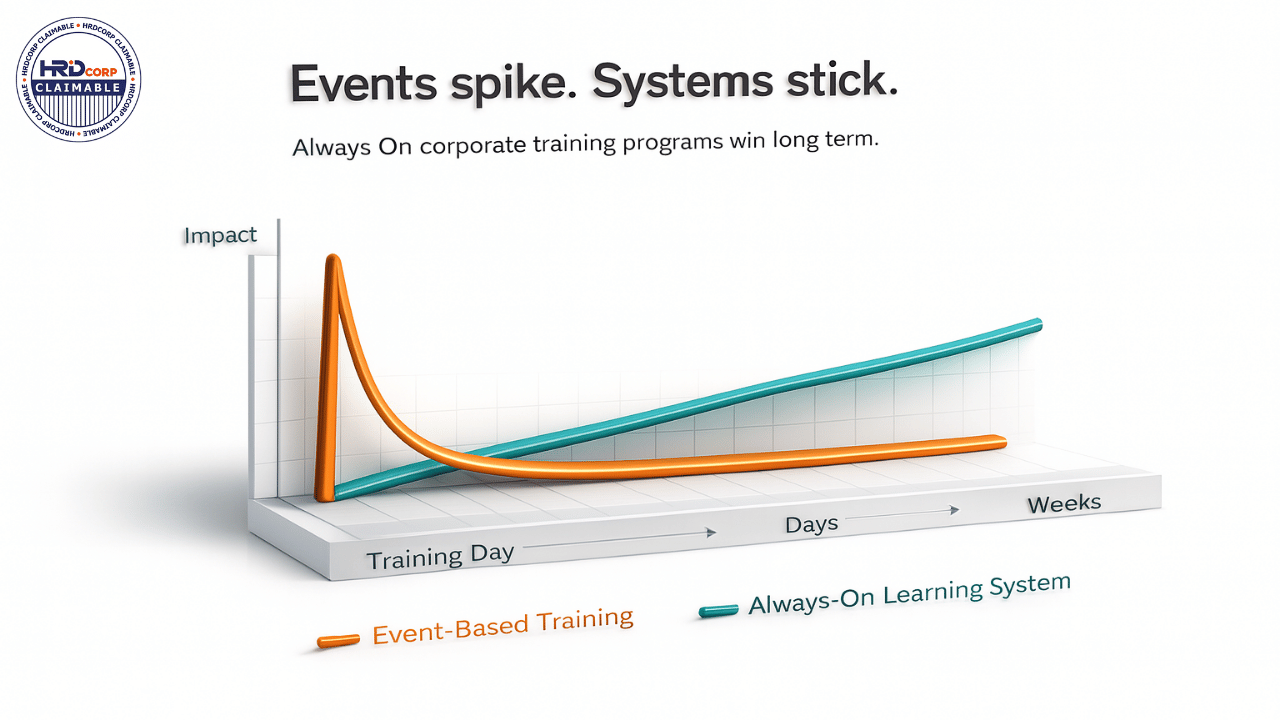
A one off format creates a predictable outcome: short term awareness, minimal behaviour change, and poor return on corporate training investment.
The Always On Learning Model, what it really means
Always On does not mean employees are “training all the time” or sitting in endless online courses for employees. It means learning is designed as a living system that keeps capability active throughout the year.
An Always On corporate training programs approach usually includes:
- A clear learning roadmap tied to performance outcomes
- Short training sessions for employees that repeat over time
- Practice tasks inside real work
- Manager reinforcement and coaching moments
- Measurement, reflection, and iteration
- Optional corporate LMS support for tracking, nudges, and resources
That is how you train and develop employees in a way that survives real pressure.
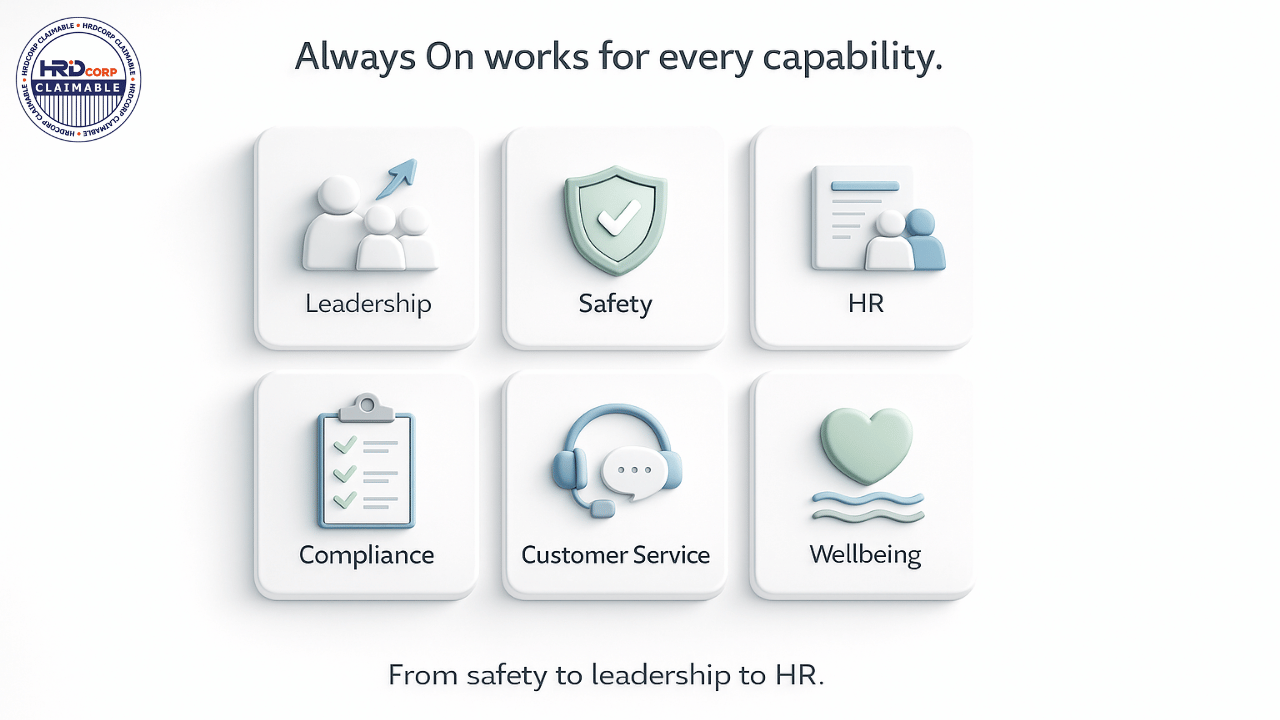
Always On learning supports every training category, not only soft skills
Some leaders assume Always On is only for leadership or corporate wellness training. In reality, it works across technical, compliance, and people capability.
Operational excellence and safety
Workplace safety training programs and occupational safety and health training work better when teams get recurring refreshers, short toolbox talks, and scenario based practice.
Leadership and management
Management training for new managers, first time supervisor training, supervisor training program, and leadership training programs for new managers become far more effective when managers are coached over time, not “certified” in a day.
HR capability
Training programs for HR employees, employee relations training, hr training programs for employees, and hr compliance training for employees require ongoing judgement building. HR work is situational. Always On helps HR teams strengthen decision quality.
Customer, sales, and service
Customer service training for employees, sales training programs for companies, corporate sales training programs, and business development training are all performance based. Performance improves with repeated practice and feedback.
Culture, inclusion, and ethics
Diversity and inclusion training in the workplace, sensitivity training for employees, unconscious bias training for employees, ethics training programs for employees, and online harassment training for employees become meaningful when reinforced through manager behaviours and team rituals.
Digital and compliance training
GDPR training for employees, corporate governance training, corporate governance courses, and corporate sustainability courses benefit from short periodic refreshers, especially when policies update or business contexts shift.
The Always On model is not a “type of course”. It is a delivery system that makes training plans for employees actually work.
How an Always On employee training program is structured
A strong employee training system usually follows a cycle. Here is a practical structure you can use for a staff training program across 6 to 12 weeks, then repeat across the year.
Step 1, Diagnose what actually needs to change
Before you decide on training courses for employees, identify the behaviour gap. This is where human resources training and development becomes strategic, not administrative.
At QIC Training, this is supported by AI driven TNA, so the organisation is not guessing. It becomes clearer what skills are missing, what mindset barriers exist, and which teams need what.
Step 2, Build a blended learning path
Always On works best when it mixes:
- A core workshop or kickoff
- Short online training courses for employees
- Live reinforcement sessions
- Manager coaching and feedback
- On the job application tasks
This is corporate learning that respects time and improves adoption.
Step 3, Make managers the multiplier
If managers are not equipped, learning dies quickly. That is why manager training and development is not optional. It is the engine.
When you run management training for managers, include:
- Coaching scripts for weekly check ins
- Simple observation checklists
- Feedback language templates
- Mini challenges the manager runs with the team
This is where corporate trainer impact becomes organisational, not individual.
Step 4, Reinforce with micro learning
Micro learning does not mean random videos. It means tight practice.
Examples:
- A two minute conflict reset routine for conflict resolution training for employees
- A short empathy prompt for emotional intelligence training for employees
- A checklist for professional development training for employees
- A quick pre shift safety refresh for safety training program for employees
Step 5, Measure what matters
Stop measuring training by attendance. Measure:
- Behaviour adoption
- Quality improvements
- Communication clarity
- Reduction in escalations
- Faster onboarding performance
- Manager consistency
- Safety incident reduction where relevant
This turns company training into performance.

A realistic example, one off workshop vs Always On
Imagine you want to improve leadership training for employees and new managers training.
- One day new manager training courses
- Some role play
- Good feedback
- Everyone returns to work
- Old habits return within weeks
- Kickoff session with a corporate instructor
- Weekly micro coaching tasks
- Manager practice in real meetings
- Peer learning circles
- Reinforcement modules
- A follow up clinic based on real challenges
- A final review that measures leadership behaviours
How HRDC training fits into the Always On model in Malaysia
For Malaysian organisations, HRDC training is a major lever because it reduces cost barriers and encourages structured development. When you build Always On pathways as HRD Corp training, you shift the conversation from isolated workshops to corporate learning plans that are:
- HRD Corp claimable
- Repeatable across teams
- Easier to scale
- Easier to measure
- Stronger ROI over time
This is where choosing the right HRDC training provider matters. A strong HRDC trainer does not only deliver content. They design reinforcement loops, manager enablement, and measurable outcomes.
If you are working with an hrdc training provider, ask if they can design:
- Annual training plan for employees
- Reinforcement based training and development programs for employees
- Blended staff training plan options
- Measurement frameworks beyond attendance
- A manager enablement layer
Also, if you are dealing with hrd corp training, ensure your program is set up properly for hrd corp claimable submissions, and that your hrd corp trainer is familiar with practical corporate training execution, not only course delivery.
What QIC Training delivers with an Always On approach
QIC Training is not built around one off corporate training. We are built around transformation.
Our model combines:
- Mindset First Approach, so behaviour change becomes possible
- Always On Learning Model, so skills become habits
- AI driven TNA, so training is targeted and measurable
- HRDC training programs that are HRD Corp claimable
We support organisations across:
- Leadership training programs for employees
- Management training for new managers and supervisor training
- Soft skills training programs for employees
- Customer service training programs for employees
- Corporate communication courses and business writing training
- Occupational safety and health training and workplace safety training programs
- Corporate wellness training and stress management training for employees
- HR training for employees and hr manager training
If your organisation is investing in corp training, the goal should not be “more training”. The goal should be a system that helps you train and develop employees consistently.
Frequently Asked Questions
Conclusion
One off workshops are not “useless”. They are simply not enough for the world your teams operate in today.
If you want real performance improvement, culture shift, and leadership consistency, your organisation needs corporate training designed as a system. That is what the Always On Learning Model delivers.
If you are planning HRDC training, corporate training, or a full employee development training roadmap for 2026, QIC Training can help you design a structured, HRD Corp claimable approach that turns learning into visible behaviour change.