Introduction
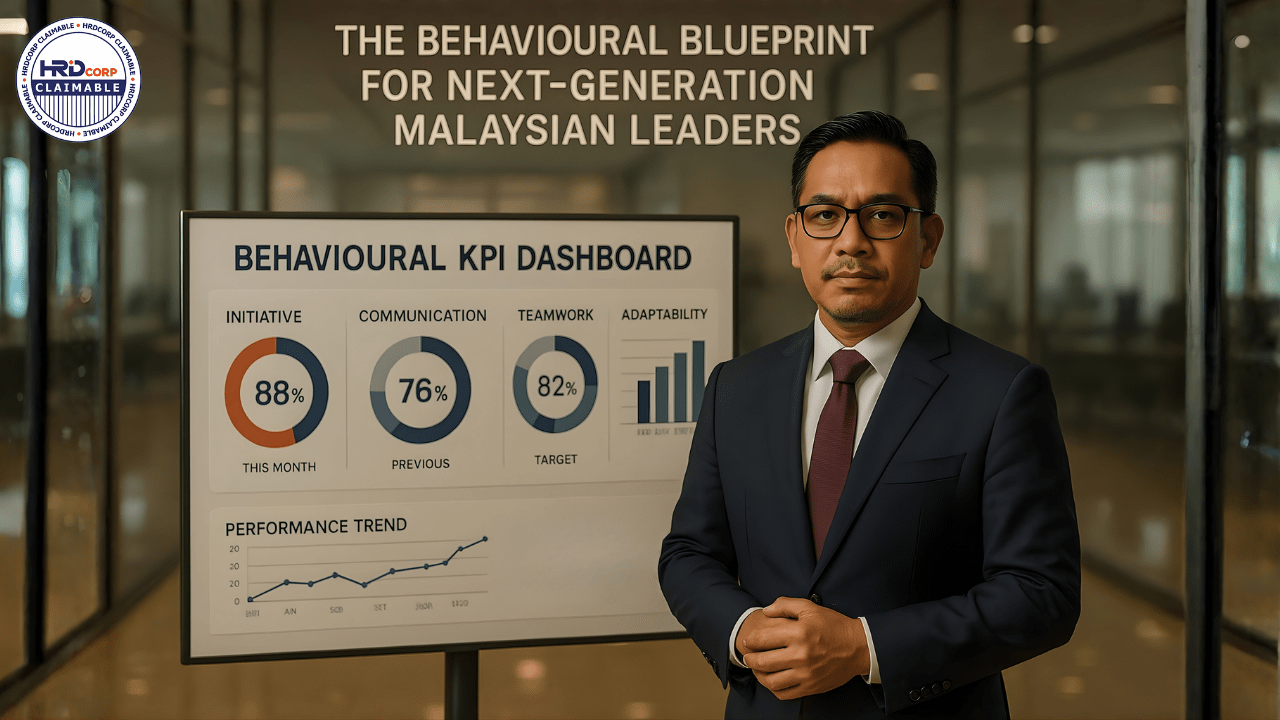
Leadership used to be defined by seniority, technical expertise, and the ability to deliver tasks. But in 2025, Malaysian organisations are discovering that none of these guarantee performance. What truly shapes a team today is not the manager’s title, it’s the manager’s behaviour.
How leaders think, communicate, regulate emotions, build trust, and make decisions now directly affects team results. This is why leadership behaviour has quietly become the most crucial KPI of the modern workplace. It also explains the surge in HRD Corp claimable leadership development programmes, people management training, emotional intelligence workshops, and coaching culture initiatives across Malaysia.
This article explores why leadership behaviours matter more than ever, what Malaysian managers must change in 2025, and how HRDC claimable courses are supporting this shift.
Why Leadership Behaviour Has Become the Ultimate KPI
The last few years reshaped the the Malaysian workplace dramatically. Hybrid work created communication gaps. Digital transformation forced faster decisions. Gen Z employees demanded openness and empathy. Economic shifts placed new pressure on teams. Through all this, companies realised something very clear: teams don’t struggle because they lack systems or skills, they struggle because leadership behaviours are outdated.
Many organisations now report that a manager’s tone, clarity, emotional stability, and consistency influence productivity far more than traditional job skills. Poorly communicated expectations lead to delays. Unregulated emotions create stressful environments. Avoidance of tough conversations causes festering conflicts. These issues accumulate until performance drops.
Leadership behaviours – not technical knowledge – now shape performance, culture, retention, customer satisfaction, and team wellbeing. When leadership behaviours are strong, teams perform. When they are weak, even talented employees become disengaged.
This is why HRD Corp eligible programmes are increasingly focused on behavioural leadership transformation, rather than technical training alone.
The Behaviour Gap: Why Malaysian Managers Are Struggling
Most Malaysian managers were promoted based on how well they performed their individual tasks, not based on how well they could lead others. The behaviours that help someone excel as an employee – such as speed, personal accountability, and technical expertise – are not the same behaviours that make someone a strong leader.
Many managers were never taught how to coach, how to communicate with clarity, how to manage conflict, or how to regulate their emotions during pressure. They often fall back on what they experienced under their own managers – methods that don’t work with today’s workforce.
Younger employees want leaders who listen and guide instead of leaders who give orders. Hybrid teams need managers who communicate consistently instead of managers who disappear until there is a crisis. High-performance environments need emotionally stable leaders who can handle stress without transferring it to their team.
This behaviour gap is exactly why HRDC claimable leadership courses – including emotional intelligence training, organisational intelligence, leadership mindset programmes, conflict management workshops, and communication training for managers – are in such high demand.
What Malaysian Managers MUST Change Today
1. The shift from commanding to coaching
Teams today want guidance, not orders. They want managers who ask questions, help them think, and support their growth. Coaching leadership builds trust, ownership, and long-term capability. It also creates more resilient teams – especially important in fast-changing industries.
2. The shift from emotional reactivity to emotional intelligence
Modern teams can’t function under emotionally unpredictable leaders. Managers must learn how to regulate stress, read emotions accurately, and respond with empathy even during difficult moments. Emotional intelligence training is becoming a staple among HRD Corp claimable courses because it directly impacts retention and team wellbeing.
3. The shift from micromanagement to trust-based empowerment
Micromanagement drains motivation and slows down progress. Employees need space to think, try, and learn. Managers must set clear expectations, trust their team to deliver, and step in only when support is needed. Trust-building is now recognised as a core leadership behaviour in high-growth Malaysian companies.
4. The shift from unclear communication to direct, consistent messaging
Confusion is expensive. Teams waste time when managers are vague or avoid difficult conversations. Strong communication behaviours – such as clarity, frequency, and honesty – help teams stay aligned even under pressure. This is why programmes on persuasion, negotiation, influencing without authority, and stakeholder communication are rising in demand.
5. The shift from firefighting to strategic thinking
Leaders who only react to problems never move the team forward. In 2025, Malaysian managers must learn to anticipate issues, interpret data, and make decisions that support long-term goals. Strategic thinking training is becoming a core requirement across industries transitioning into AI, digital transformation, and future skills readiness.
How HRD Corp Claimable Courses Support Behavioural Leadership Transformation
Many HR departments initially believed HRD Corp was mainly for technical or compliance training. But leadership behaviour development is now one of the most valuable areas to invest levy funds.
HRD Corp claimable programmes now regularly cover leadership mindset development, people management training, emotional intelligence, conflict management, change leadership, and organisational intelligence. These courses help managers shift their behaviour in real, practical ways.
Companies that use HRD Corp levy funds strategically are seeing stronger leadership pipelines, better communication cultures, and higher employee engagement. Many also report improved productivity and fewer burnout cases – direct results of healthier leadership behaviour.
Why Behaviour Change Requires an Always-On Learning Model
Leadership behaviour does not change in a day. It doesn’t transform from a single workshop or a one-time lecture. Behaviour change requires continuous reinforcement, regular practice, and structured guidance.
This is why QIC Training built the Always-On Learning Model. The model begins by understanding a team’s mindset and performance challenges, then designs leadership journeys tailored to those gaps. These journeys include coaching, assessments, reinforcement sessions, and measurable outcomes. It shifts learning from “training day” to “training habit”.
This approach helps leaders build behaviours that stick – not behaviours that disappear a week after training.
Common FAQs About Leadership Behaviours as KPIs
Q
Why are leadership behaviours suddenly so important in Malaysia?
Because the workplace has changed faster than leadership styles. Hybrid teams, younger employees, and constant change need leaders who can communicate clearly, stay emotionally steady, and coach instead of command. Behaviour drives performance more than technical skills now – and companies that ignore this fall behind quickly.
Q
Can leadership behaviours really be trained?
Absolutely. Behaviour isn’t fixed – it’s learned. With the right approach (mindset-first, not just skill-first), leaders can learn to communicate better, manage emotions, and build trust. We see huge shifts even after short HRDC claimable leadership programmes when reinforcement is done right.
Q
How long does it take for managers to change behaviour?
A single workshop can spark awareness, but real behaviour change happens over weeks – not hours. That’s why our Always-On Learning Model reinforces learning through coaching, reflection, and ongoing support. The goal is consistency, not perfection.
Q
Is leadership behaviour training HRD Corp claimable?
Yes. Most of QIC’s leadership and people management programmes fall under HRD Corp eligible categories. This includes emotional intelligence, communication for managers, conflict management, leadership mindset development, and coaching culture workshops. You can fully claim them under your levy.
Q
What type of leadership training is best for underperforming teams?
Teams struggling with engagement, miscommunication, or burnout usually need leaders who improve clarity, empathy, and structure. Programmes like Leadership Essentials, Emotional Intelligence for Managers, and Organisational Intelligence create fast, noticeable change.
Q
What results can a company realistically expect?
Companies typically see better communication, improved morale, fewer conflicts, faster decision-making, and stronger ownership from employees. Many report higher productivity and lower turnover within months – because when leaders change, the team follows.
Q
Do SMEs benefit from leadership behaviour training too?
More than anyone. In smaller teams, one leader’s behaviour affects everyone. A single manager who communicates poorly or reacts emotionally can derail an entire SME. Behaviour-driven leadership training often produces the fastest ROI in smaller organisations.
The Bottom Line: Behaviour Is the Future of Leadership KPI
In 2025, Malaysian organisations will increasingly evaluate managers not by their output, but by how they show up. The way managers speak, listen, guide, react, and decide has more impact on performance than any system or SOP ever could.
When leadership behaviour is strong, teams are motivated, productive, and aligned. When leadership behaviour is weak, even the most skilled teams struggle. That’s why behavioural leadership transformation – supported by HRD Corp claimable courses – is now the most important investment a company can make.
Leadership is evolving. Managers who evolve with it will shape Malaysia’s future workforce. Those who don’t will be left behind as the workplace demands more from leaders every year.
Want to Build Behaviour-Driven Leaders?
QIC Training offers HRDC claimable leadership programmes designed around real behaviour change. These include leadership development, people management training, emotional intelligence workshops, organisational intelligence programmes, change management training, and strategic communication courses.
To learn how QIC can transform your managers into behaviour-driven leaders, connect with our team and start designing your leadership behaviour roadmap today.