Introduction
The future of enterprise technology is no longer centralized—it is decentralised. With global operations, complex supply chains, and increasing regulatory scrutiny, organizations face mounting challenges in data integrity, transparency, and security. Traditional ERP systems have long facilitated integration across finance, HR, procurement, and production. However, these systems rely on centralized databases, creating vulnerabilities such as single points of failure, opaque transactions, and cumbersome reconciliations.
Blockchain technology introduces distributed ledgers—tamper-proof, auditable records shared across multiple nodes—which can redefine enterprise operations. A blockchain-enabled ERP ensures that every transaction is verified, secure, and traceable, across departments, subsidiaries, and even multiple organizations. For Malaysian and global enterprises, this integration promises trustless, transparent, and efficient business workflows, offering resilience in an era of cybersecurity threats and compliance demands.
In this blog, we explore how decentralised ERP systems built on blockchain are transforming business operations, the industry benefits, architecture, adoption trends, and best practices for implementation in 2025 and beyond.
Inter-Enterprise Collaboration and Compliance in Blockchain ERP
One of the most transformative aspects of blockchain-enabled ERP systems lies in their ability to facilitate seamless collaboration across multiple enterprises while maintaining full transparency and compliance. Unlike traditional ERP systems, which are often siloed within a single organization, blockchain ERP creates a shared, immutable ledger accessible to all authorized stakeholders—suppliers, logistics providers, distributors, regulators, and even financial institutions.
This decentralization allows enterprises to work together in real time without the delays and reconciliation efforts typically associated with cross-company transactions. For example, in the manufacturing sector, a component sourced from an overseas supplier can be logged immediately into the blockchain ERP system, verified by multiple nodes, and simultaneously updated in the procurement and production modules. This level of visibility reduces the likelihood of errors, counterfeit parts, or delivery disputes, and ensures that every participant has a single source of truth.
In addition to improving operational efficiency, blockchain ERP addresses critical regulatory and compliance requirements. Many industries, including pharmaceuticals, food and beverage, and electronics, are subject to stringent local and international regulations concerning product traceability, environmental standards, and data privacy. By recording all transactions in an immutable ledger, blockchain ERP automatically generates an auditable trail, simplifying reporting and reducing the administrative burden on internal compliance teams. Malaysian enterprises, for example, can ensure alignment with PDPA regulations while also adhering to global standards such as ISO 27001, SOC 2, and GDPR for international operations.
Blockchain ERP also enhances financial transparency and risk management. Through smart contracts, payments are automated and executed only when predefined conditions are met, reducing disputes and delays. Multi-party verification ensures that financial data—whether intercompany invoices, cross-border payments, or tax filings—cannot be altered without consensus. Moreover, the distributed nature of blockchain ERP mitigates the risk of downtime due to server failures or cyberattacks, ensuring continuity for mission-critical operations across multiple business entities.
Another significant advantage lies in collaborative supply chain optimization. Blockchain ERP enables real-time analytics across multiple organizations, allowing enterprises to detect bottlenecks, forecast inventory shortages, and coordinate deliveries more effectively. Suppliers, manufacturers, and retailers can synchronize operations using verified blockchain data, improving efficiency while reducing costs and environmental impact. This convergence of blockchain, ERP, and AI supports innovation by enabling new business models, dynamic pricing, and decentralized logistics networks—all with the security and auditability guaranteed by blockchain.
The Centralization Dilemma in Traditional ERP
- Limited Transparency: Stakeholders cannot independently verify data integrity, making audits and compliance reporting difficult.
- Data Manipulation Risks: Centralized systems can be altered intentionally or accidentally, with no immutable record.
- Complex Reconciliations: Multi-subsidiary, partner, and cross-border operations require frequent, time-consuming reconciliations.
- Security Vulnerabilities: Centralized ERP databases are high-value targets for cyberattacks, ransomware, and insider threats.
- Trust Deficit: Verifying authenticity across global supply chains remains cumbersome, limiting collaboration and efficiency.
These limitations highlight the need for a trustless, auditable, and secure ERP ecosystem—blockchain provides the foundation.
How Blockchain Reinvents ERP Systems
1. Immutable and Transparent Data Records
Every transaction is timestamped, encrypted, and shared across authorized nodes. Once a record is added, it cannot be altered or deleted, ensuring integrity and auditable proof.
2. Smart Contracts for Automated Workflows
Self-executing agreements trigger actions when conditions are met. For example, IoT sensors verify delivery; then payment and inventory updates occur automatically.
3. Decentralised Data Management
Distributed ledgers store data across nodes rather than a single database, mitigating single-point failures and cyber risks.
4. Enhanced Security Through Cryptography
Consensus mechanisms (e.g., PoS, PBFT) and cryptography prevent unauthorized tampering and secure end-to-end transactions.
5. Trust Across Supply Chains
Shared visibility across suppliers, distributors, and regulators enables real-time verification—critical for provenance and traceability.
Industry Applications of Blockchain-Enabled ERP
Manufacturing & Supply Chain
- Trace components from raw material to finished product.
- Improve recall management and fraud prevention.
- Enhance cross-subsidiary coordination via shared ledgers.
Finance & Accounting
- Automate invoice approvals, compliance checks, and cross-entity payments with smart contracts.
- Eliminate duplicate ledger entries and reduce manual reconciliations.
- Improve audit readiness and financial transparency.
Healthcare
- Protect patient records while enabling authorized data sharing.
- Monitor medical supply chains with full traceability.
- Ensure compliance with local and international data regulations.
Logistics & Trade
- Automate customs documentation and cross-border verification.
- Monitor shipments and payments in real time.
- Reduce delays, paperwork, and errors across partners.
Public Sector & Governance
- Transparent procurement and subsidy disbursements.
- Audit-ready citizen services, reducing fraud and inefficiency.
- Streamlined vendor management with immutable records.
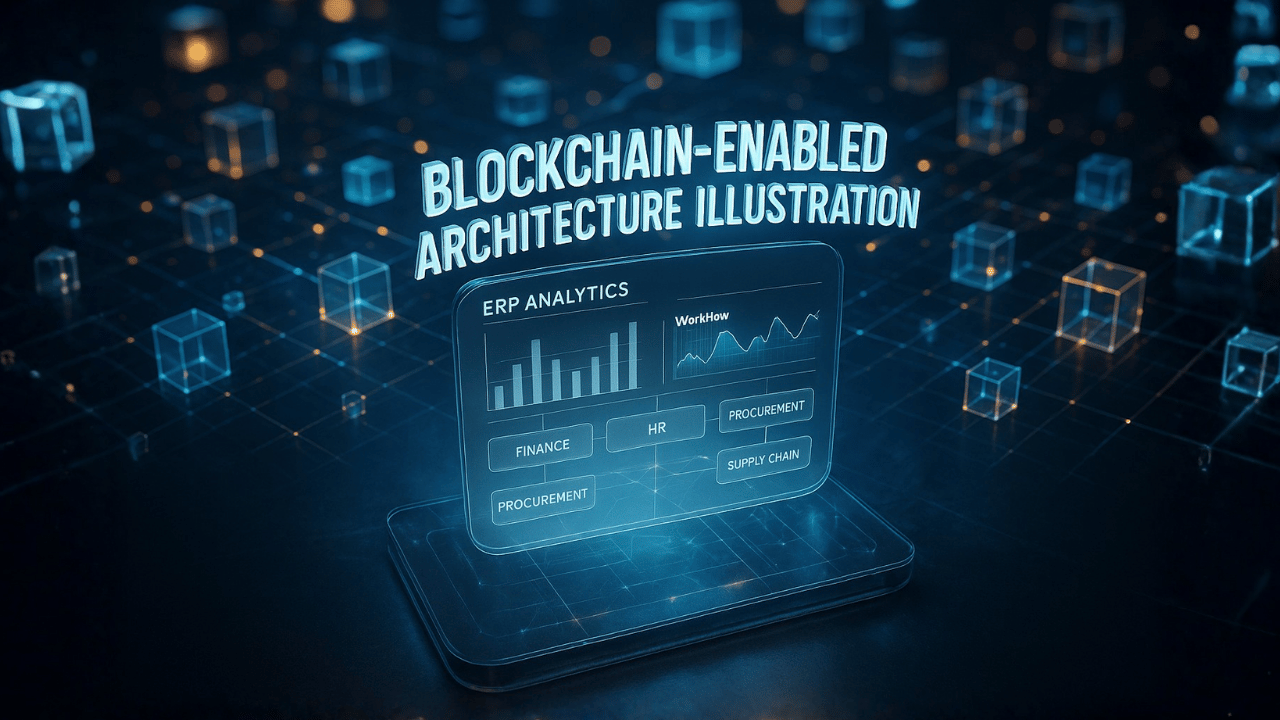
The Architecture of Decentralised ERP
- Blockchain Layer: Distributed ledgers, encryption, and consensus.
- ERP Layer: Business logic for finance, HR, procurement, production, and inventory.
- Integration Layer: Secure connections to IoT, APIs, external systems.
- Analytics Layer: AI and visualisation for insight and decision-making.
Data, Stats & Global Adoption Trends
- Deloitte (2024): 55% of global enterprises plan to integrate blockchain into ERP by 2027.
- MarketsandMarkets: Blockchain ERP market projected to hit USD 2.5B by 2030 (CAGR 47%).
- SAP & IBM: Major ERP providers embedding blockchain for supply chain transparency.
- Case (Malaysia): Electronics manufacturer using Hyperledger Fabric achieved 100% parts traceability and 30% lower audit costs.
Benefits of Blockchain-Enabled ERP
| Category | Traditional ERP | Blockchain ERP |
|---|---|---|
| Data Control | Centralized database | Distributed ledger |
| Security | Higher single-point breach risk | Cryptographically secured; consensus-guarded |
| Transparency | Limited, internal-only visibility | Shared, real-time, immutable view |
| Automation | Manual / rule-based | Smart contract–driven workflows |
| Trust Model | Central authority | Consensus-based trust |
Additional Advantages
- Cross-Enterprise Collaboration: Secure multi-party operations without a central authority.
- Regulatory Compliance: Immutable records simplify PDPA/GDPR/industry reporting.
- Operational Efficiency: Smart contracts reduce human error and delays.
- Auditability: Real-time and historical access improves audits.
Challenges & Considerations
- Integration Complexity: Legacy redesign may be required.
- Regulatory Ambiguity: Standards for decentralized ERP are evolving.
- Scalability: Public chains can experience latency; consider private/consortium chains.
- Change Management: Upskilling on blockchain governance and workflows.
- Cost & ROI: Significant initial investment—plan carefully.
Common FAQs About Blockchain-Enabled ERP
Q What is a blockchain-enabled ERP system?
A blockchain-enabled ERP integrates distributed ledger technology into traditional ERP systems to make transactions immutable, transparent, and verifiable.
Q How is decentralised ERP different from traditional ERP?
Decentralised ERP distributes data across multiple nodes, reducing single points of failure, enhancing security, and enabling trustless collaboration.
Q Which industries benefit most from blockchain ERP?
Manufacturing, logistics, healthcare, finance, and the public sector—where traceability, compliance, and trust are critical.
Q Is blockchain ERP suitable for SMEs?
Yes. Modular and cloud-based blockchain ERP platforms enable cost-effective adoption for small and mid-sized enterprises.
The Way Ahead
Decentralized ERP represents a paradigm shift—not just a technology upgrade. By integrating blockchain transparency with ERP efficiency, enterprises create systems of trust across stakeholders, geographies, and partners. If you’re ready to explore next steps, you can schedule a consultation with our team to map a pragmatic, ROI-backed adoption plan.
At QIC Training & Consultancy, we guide organizations through blockchain ERP transformation, including strategy, smart contracts, supply chain transparency, and compliance alignment (PDPA, ISO 27001, and international standards).
Conclusion
The fusion of blockchain and ERP marks the next frontier of enterprise systems—trust, transparency, and decentralization. Blockchain ERP transforms traditional data management from centralized control to consensus-driven networks. By 2025 and beyond, blockchain-enabled ERP will define resilient, secure, and agile operations; early adopters will set the standard for operational trust and digital-transformation excellence.