

Introduction
Productivity is one of the biggest conversations in Malaysian workplaces right now. Companies spend heavily on digital tools, workflow systems, performance software, and even HRDC claimable training to improve output. Yet despite all that, teams often remain slow, disengaged, confused, or overwhelmed. Deadlines slip. Meetings drag. Miscommunication multiplies. The frustration rises silently until it becomes normal – “like that one.”
According to Gallup’s global research, 70% of team productivity is determined directly by the manager’s behaviour, not the team’s skills, tools, or training. McKinsey’s 2024 organisational health index shows that employees with emotionally intelligent, communicative managers deliver up to 30% higher productivity. Locally, a Malaysian HR survey involving 3,200 employees found that poor leadership behaviour is the number one cause of slow performance, ahead of workload, lack of skill, or unclear processes.
The tricky part? Most managers aren’t intentionally hurting productivity – they simply don’t realise how their behaviour impacts the people around them.
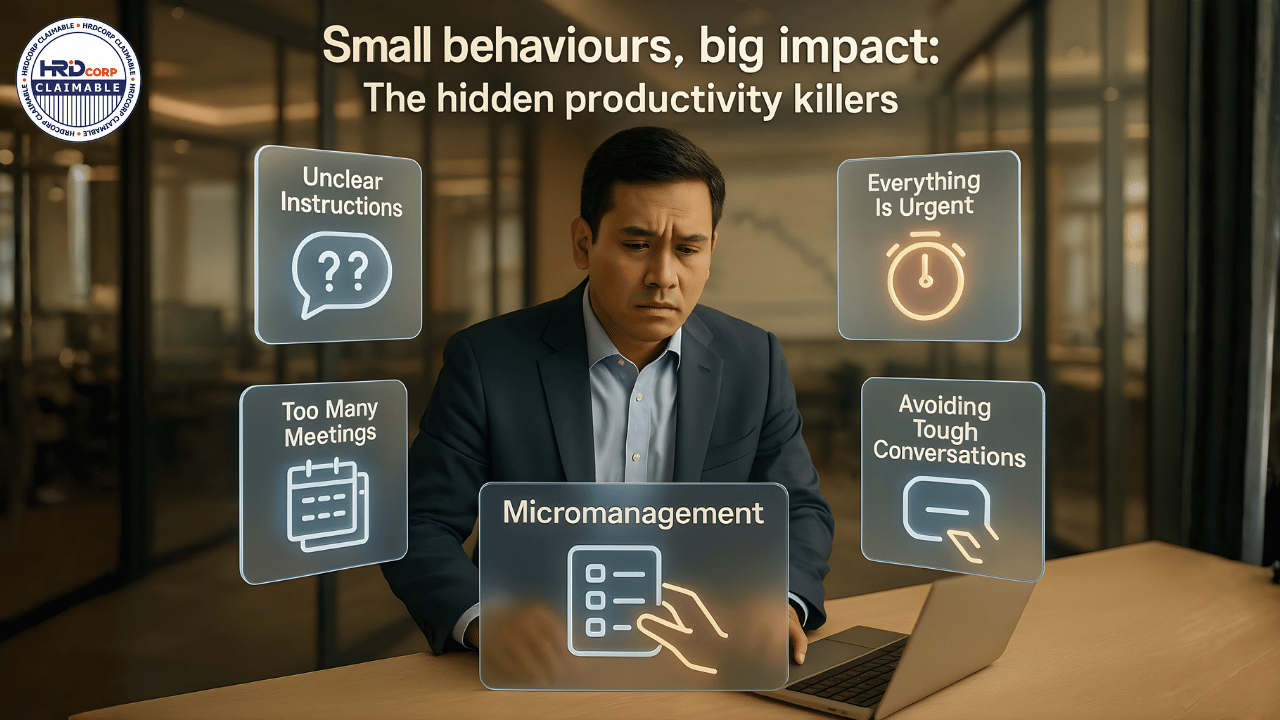
Here are the five most common behaviours Malaysian managers unknowingly practise, and how a mindset-first, HRD Corp claimable leadership transformation can turn everything around.
1. Being Unclear and Assuming People “Should Know”
A shocking number of productivity issues in Malaysia come from unclear instructions. Managers often say things like “use your initiative,” “you know what to do,” or “just get it done,” expecting employees to interpret the full intention. But Malaysian workplace culture is built on politeness, deference, and reading between the lines – which means employees often hesitate to ask clarifying questions in fear of “disturbing” the manager or looking incompetent.
The result is predictable: wrong assumptions, repeated work, avoidable delays, and endless back-and-forth messages.
Harvard Business Review notes that unclear communication can reduce productivity by up to 40%, and Malaysian HR consultants report that miscommunication remains one of the top triggers of workplace conflict.
Clarity is not a skill – it’s a behaviour. It requires managers to reshape the mindset from “They should know” to “It’s my responsibility to make sure they do.”
2. Making Every Task Urgent, Creating Silent Burnout
Many Malaysian teams operate in “panic mode” because managers unintentionally label everything as urgent. When every request sounds like a crisis, employees lose the ability to prioritise. Stress levels rise. Decision-making weakens. Motivation declines.
A Deloitte SEA report on burnout in Malaysia found that 64% of employees experience stress because of unrealistic timelines, most of which originate from leadership behaviour rather than actual workload. When urgency becomes the norm, teams stop feeling urgency altogether. Productivity doesn’t rise – it collapses.
Managers often do this unintentionally. They may genuinely feel pressure from upper management and pass it downward. But without a shift in mindset around planning, delegation, and emotional regulation, a stressed manager ends up transferring stress instead of direction.
3. Using Meetings as a Default Instead of a Tool
Malaysia loves meetings – sometimes too much. A 2023 Malaysia Productivity Corporation (MPC) study found that employees spend an average of 17 hours per week in meetings, yet rate more than half of them as “unnecessary.” Many managers use meetings as a form of control, a catch-all communication tool, or a substitute for difficult one-on-one conversations.
But meetings break focus, interrupt workflow, and create “performative productivity,” where people feel busy without actually producing results. The worst part is that managers rarely notice it happening because they’re the ones talking the most in those meetings.
High-performing companies worldwide now encourage a culture of fewer, shorter, and goal-driven gatherings. Productivity rises not when people attend meetings, but when they have long, uninterrupted blocks of deep work.
4. Avoiding Difficult Conversations – Leading to Silent Problems
Conflict avoidance is deeply ingrained in Malaysian culture. We prioritise harmony, politeness, and face-saving – often at the expense of transparency. Managers who avoid difficult conversations think they’re protecting relationships, but they’re actually allowing problems to grow quietly in the background.
Underperformance continues because it’s never addressed. Toxic behaviours go unchecked because confronting them feels uncomfortable. Confusion lingers because expectations were never clarified.
A LinkedIn Workforce Learning Report revealed that 57% of employees say unclear feedback is a major barrier to better performance. Locally, Malaysian HR practitioners estimate that over 45% of performance issues go unaddressed for months because managers simply don’t know how to initiate honest, emotionally intelligent dialogue.
Avoidance feels safe – but it’s a silent productivity killer.
5. Over-Managing Tasks Instead of Leading People
Micromanagement is one of the top complaints in Malaysian organisations. Many managers were promoted for being good doers, not good leaders. They don’t intend to micromanage – they simply don’t know any other way to lead. But micromanagement destroys productivity by crushing autonomy, slowing decisions, and making employees dependent instead of capable.
A study by the University of Birmingham found that teams given high autonomy perform 20–30% better than teams with low autonomy. In Malaysia, recruitment agencies consistently report that poor managerial trust and over-control are among the top reasons employees leave companies.
Micromanagement isn’t a work problem. It’s a mindset problem – one rooted in fear, insecurity, or the belief that “things only get done right if I do it myself.”
When managers learn to lead people instead of tasks, productivity rises naturally.
What Mindset-First Learning Does Differently
Skills training – whether time management, communication skills, problem-solving workshops, or soft skills training Malaysia – doesn’t solve these issues by itself. These behaviours come from beliefs, habits, and emotional patterns that no slideshow can undo.
Mindset-first training changes the foundation. It helps managers reflect on their behaviour, identify blind spots, recognise emotional triggers, and understand how their actions shape the environment around them.
Before teaching skills like delegation, persuasion, coaching, or strategic thinking, it teaches awareness, empathy, and intention. This is why HRDC claimable leadership development programmes rooted in behavioural science produce far more meaningful and sustainable performance improvements.
When mindset shifts, behaviour changes. When behaviour changes, productivity follows.
The Malaysian Workplace Needs Behaviour-Driven Leadership Now
Malaysia’s workforce is changing. Gen Z is entering the workplace with higher expectations for empathy, transparency, and psychological safety. Hybrid work requires clearer communication. Digital transformation requires adaptability and confidence. Diversity requires emotional intelligence. High workload environments require calm, not chaos.
In this landscape, leadership behaviour is the biggest productivity multiplier – or the biggest productivity barrier.
Companies that invest in behaviour-driven, HRD Corp claimable leadership development Malaysia programmes are seeing clearer communication, stronger teamwork, better decision-making, and significantly higher engagement.
The best part? Behavioural transformation is completely claimable under HRD Corp levy funds, making it one of the highest ROI investments Malaysian organisations can make.
FAQ
Q Why do Malaysian managers unintentionally hurt productivity?
Many behaviours are habits formed over years of workplace norms, not intentional choices. Without awareness and a shift in mindset, managers simply repeat what they’ve seen, even if it slows the team down.
Q Can leadership behaviour be changed?
Yes – with mindset-first training, reflection, and guided practice. When managers understand how their beliefs drive their actions, they can consciously change both.
Q Is leadership behaviour training HRD Corp claimable?
Most behavioural and leadership development programmes are fully claimable under HRD Corp, especially those focused on communication, emotional intelligence, coaching skills, and mindset-based leadership development.
Q How fast can productivity improve?
Teams often show improvement within weeks once managers change communication, clarity, and priority-setting habits. When mindset and behaviour shift, productivity tends to follow quickly.
Q Does mindset-first learning really work?
Companies that adopt a mindset-first learning approach consistently report better engagement, clearer communication, and higher productivity – because they are fixing the root cause, not just the symptoms.
Conclusion
Most managers don’t set out to hurt productivity. They genuinely want their teams to succeed. But without real awareness of how their own behaviour shapes the environment, small habits can have massive consequences.
Unclear communication, unnecessary urgency, meeting overload, conflict avoidance, and micromanagement aren’t skill problems – they are mindset problems. And mindset problems require mindset-first solutions.
If Malaysia wants stronger teams, higher performance, and a healthier workplace culture, the shift must start with the people who influence productivity the most: the managers.
Change the mindset, and productivity follows. Change the behaviour, and culture follows. Change the leaders, and everything follows.
From Skills Gaps to Business Wins
From Skills Gaps to Business Wins
Take the First Step.